Emotional burnout: symptoms, stages and recovery
A psychotherapist explains how to spot burnout early, how it differs from depression and what to do when a holiday no longer helps.
Emotional burnout creeps up unnoticed. At first work simply wears you out more than usual. Then the weekend stops being enough to recover. After a while you catch yourself not caring: about clients, about results, about praise. And that "I don't care" is more frightening than the tiredness.
In this article we'll look at what emotional burnout is, how it shows up, what stages it goes through and how to recover if you are already at one of them.
What emotional burnout is
Emotional burnout is a state of exhaustion that develops from long-term stress at work that a person can't manage. The term appeared in the 1970s, when psychologists noticed that the most committed people burned out first: doctors, teachers, social workers.
In 2019 the World Health Organization included burnout in the International Classification of Diseases (ICD-11, code QD85). An important detail: there it is described as an occupational phenomenon, not as a medical condition. It is defined by three features:
- Exhaustion. A feeling that your energy has run out and there is nothing to refill it with.
- Detachment and cynicism. A person emotionally distances themselves from work, colleagues and clients and starts treating them coldly or with irritation.
- Reduced effectiveness. It feels as if work brings nothing and changes nothing, and your own results don't matter.
Today burnout is discussed beyond work too. Parents burn out, as do people who care for a sick relative for a long time, and volunteers. The mechanism is the same: for a long time a person gives more than they restore.
Symptoms of emotional burnout
The signs of burnout fall conveniently into three groups.
Emotional:
- tiredness that doesn't go away after weekends or holidays;
- irritation over small things, especially with the people you work with;
- indifference to what used to inspire you;
- a feeling that nobody values you;
- Sunday-evening anxiety before the working week.
Behavioural:
- you put off tasks you used to do quickly;
- you take more breaks and scroll your phone just to avoid starting;
- you cut contact with colleagues to a minimum;
- more coffee, sweets and alcohol "to relax."
Physical:
- sleep problems: it's hard to fall asleep because of thoughts about work, or you wake up feeling broken;
- frequent colds, headaches, tension in the neck and shoulders;
- stomach problems, changes in appetite.
A simple check: imagine you don't have to go to work tomorrow. If your first reaction is relief, followed by guilt, it's worth taking a closer look at how you are.
Stages of burnout
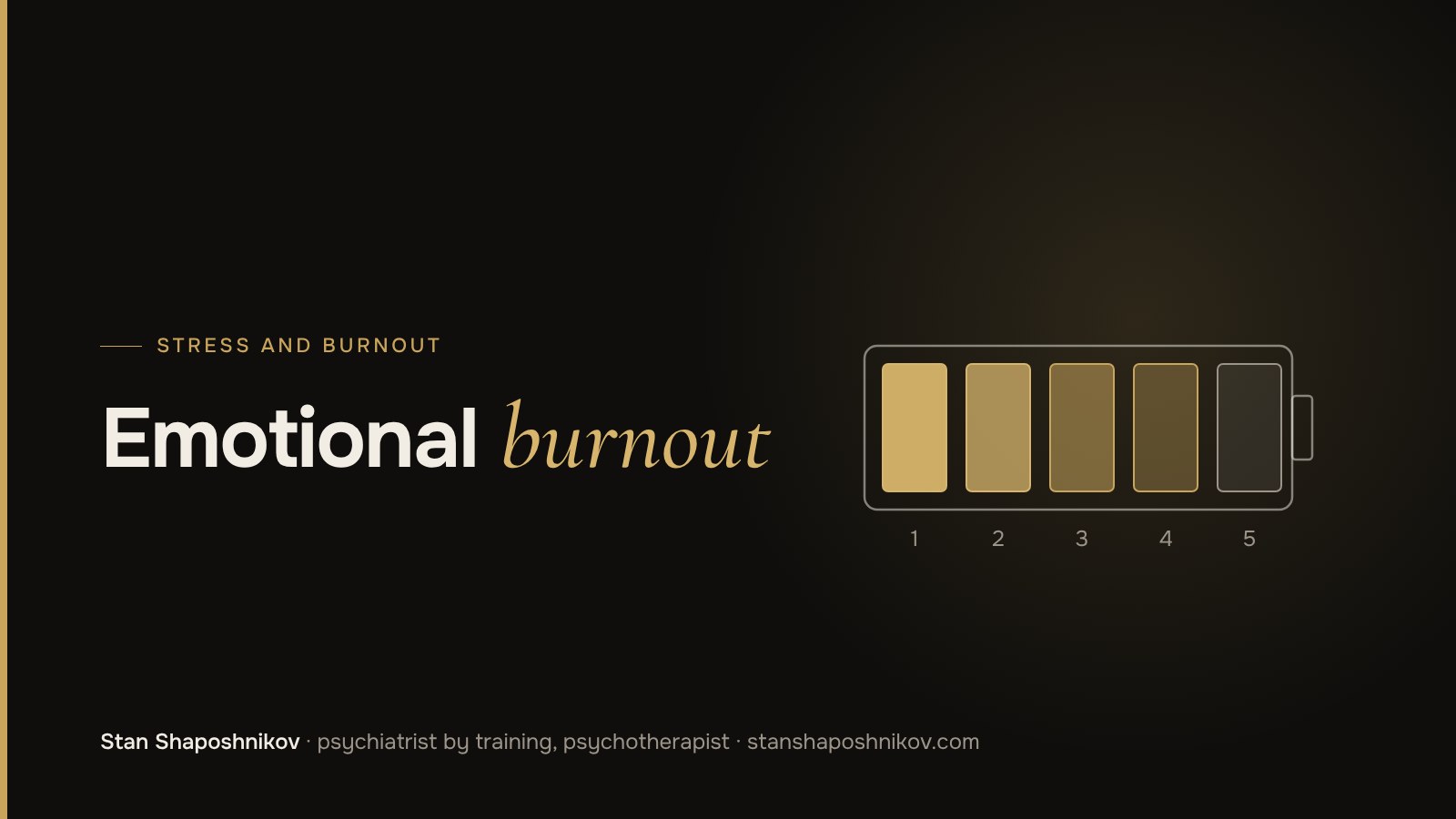
Burnout develops over months and even years. One of the best-known models, Greenberg's, describes five stages.
- Honeymoon. The person is full of enthusiasm, works a lot and enjoys it. There is stress, but enough energy. This is where future burnout is laid down: the habit of working at the limit feels normal.
- Fuel shortage. Tiredness appears, interest drops, sleep gets worse. To keep up the pace, the person increasingly "pushes" themselves: coffee, sweets, working late.
- Chronic symptoms. Constant tiredness, irritability, frequent illness. A feeling of always being short of time.
- Crisis. Health problems begin, along with pessimism and a sense of being trapped. The person seriously thinks about leaving the job or the profession.
- Hitting the wall. The exhaustion becomes so severe that it interferes with work and life. At this stage burnout often turns into depression or serious health problems.
The earlier you notice burnout, the easier it is to get out of it. In the first two stages, changing your routine and workload is often enough. In the fourth and fifth, you usually need a specialist's help.
Why people burn out
The causes of burnout lie both in the work and in the person.
On the work side: too many tasks, little control over how to do them, no recognition, unfairness, work that goes against your own values, constant uncertainty.
On the person's side: a tendency towards perfectionism, difficulty saying no, a habit of taking responsibility for everything around.
In the memetics of personality I look at such habits as "firmware": beliefs a person once learned and has never checked since. Among those who burn out, these are the most common:
- "I have to cope on my own";
- "rest is for the weak";
- "I'm valued as long as I'm useful";
- "if not me, then nobody."
For a long time these beliefs work in the person's favour: thanks to them they achieve a lot. But when the load grows, they don't let the person stop in time, ask for help or drop what's unnecessary. While such a belief is in charge, a holiday helps only briefly: the person comes back and works by the same rules again.
Burnout or depression
Burnout and depression look alike, and one can turn into the other. The main difference is how widely the state spreads.
With burnout, a person gets tired of and loses interest mainly in work, but still enjoys weekends, hobbies and time with loved ones. With depression, interest in everything disappears, low mood holds almost every day, and feelings of worthlessness and thoughts of death appear.
If you recognise yourself in the second description, read the article "Symptoms of depression" and see a doctor. Depression needs treatment, not waiting out. If you're not sure whether you're lazy or burned out, there's an article "Burnout or laziness? How to tell what's really happening to you".
How to check yourself: burnout tests
To assess burnout, psychologists use standardised questionnaires. The best known are the Maslach Burnout Inventory (MBI) and V. V. Boyko's emotional burnout questionnaire, often used in Russian-speaking countries. Both show how pronounced exhaustion, detachment and reduced effectiveness are.
A test doesn't make a diagnosis. It helps you see where you are now and track whether things are getting better. If your score is high, that's a reason to talk to a specialist.
How to recover from emotional burnout
1. Admit that it's burnout, not weakness
Many people keep scolding themselves: "other people manage." Self-criticism takes the last of your energy. Burnout grows out of long-term overload, and your character has nothing to do with it.
2. Remove at least one unnecessary load
Look at your week and find one task, meeting or commitment you can drop or hand to someone else. Starting with one item is easier than rebuilding everything at once.
3. Bring back the boundary between work and rest
A time when you don't answer work messages. A place at home where you don't work. Without these boundaries the brain doesn't switch off, and even free time doesn't restore you.
4. Restore your body
7–8 hours of sleep, movement every day, even just a walk, less alcohol and caffeine. With burnout the body has long been running on credit, and without this base the other steps won't work.
5. Bring back one thing that fills you up
Something just for yourself, without goals or reporting: music, drawing, sport, nature. Burnout narrows life down to work, and such activities widen it again.
6. Examine your rules
Ask yourself: what rules do I work by? "I must always be available," "I can't let the team down," "I can't show I'm tired." Whose rules are these? Do they suit me now? Without this step burnout often comes back.
When you need a specialist's help
See a psychotherapist or doctor if:
- the state has lasted more than a few months and doesn't improve after a holiday;
- sleep problems, frequent illnesses or pain without an obvious cause have appeared;
- interest has disappeared not only in work but in everything else too;
- thoughts that you don't want to live have appeared. In that case help is needed urgently: call emergency services or a crisis helpline in your country.
In my work I combine cognitive behavioural therapy with analysing the "firmware" through memetics. We find the beliefs that make a person work themselves to exhaustion again and again, and change them so that recovery lasts.
Preventing emotional burnout
The best prevention is to notice your state regularly instead of waiting for a crisis. Once a week ask yourself three questions: how much energy do I have now on a scale of 1 to 10, what took it, and what restored it? If the number stays below five for several weeks in a row, it's time to change something.
If you are a manager, burnout in your team is worth tracking just like deadlines and budget. My corporate programmes are dedicated to working with teams.
Frequently asked questions
What is emotional burnout in plain words?
It's exhaustion that develops from long-term stress at work. A person feels they have no energy left, distances themselves from work and people, and stops seeing meaning in their results.
How long does it take to recover from burnout?
In the early stages, a few weeks if you reduce the load and restore rest. With severe burnout recovery can take several months, and a specialist's help is usually needed.
Will a holiday help with burnout?
In the early stages it will. With deep burnout a holiday gives a short break, but if you return to the same workload and the same habits, the symptoms quickly come back.
Is burnout an illness?
In ICD-11 burnout is described as an occupational phenomenon, not an illness. But it can lead to depression, anxiety disorders and health problems, so it should be taken seriously.
What are the stages of emotional burnout?
According to Greenberg's model there are five: honeymoon, fuel shortage, chronic symptoms, crisis and "hitting the wall." The earlier the stage, the easier it is to recover.
Can you burn out outside work?
Yes. Parents burn out, as do people who care for a sick relative for a long time, and volunteers. The mechanism is the same: giving more than you restore over a long period.