Panic attack: symptoms and what to do during an attack
A psychotherapist explains how a panic attack shows up, how it differs from a heart problem and how to get through an attack without running from it.
Your heart is pounding so hard you can hear it. You can't get enough air, your fingers go numb, your head is spinning. One thought feels like the only true one: "I'm about to die." Twenty minutes later it's over, and the paramedic says your heart is fine.
That is what a first panic attack usually looks like. Below we'll go through the symptoms, how to tell an attack from a heart problem, what to do during one and how panic attacks are treated in therapy.
What a panic attack is, in plain words
A panic attack is a sudden surge of intense fear with a violent reaction in the body. The body switches on its fight-or-flight response at full power, even though there is no real danger nearby.
The sensations are completely real. Your heart really does beat faster, your breathing really does go off rhythm. But these changes don't damage the heart or the brain. People don't die from panic attacks, don't go mad and don't lose control of themselves, even though that is exactly what they fear during an attack.
Panic attacks are more common than most people think. According to the World Mental Health Surveys, about 13% of people have had at least one panic attack in their lifetime. Panic disorder, when attacks keep coming and a person starts living in fear of the next one, is rarer: about 1.7%.
Panic attack symptoms
A panic attack has two groups of signs: physical and mental. For a doctor to call an episode a panic attack, there are usually at least four from the list below.
What happens in the body:
- a pounding heart, a feeling that it is "jumping out" of your chest or skipping beats;
- shortness of breath, a feeling that you can't take a full breath;
- a lump in the throat, a sense of choking;
- pain or tightness in the chest;
- trembling, chills or, the opposite, a wave of heat;
- sweating;
- dizziness, weak legs, a feeling that you are about to faint;
- nausea, a cramp in the stomach;
- numbness or tingling in the fingers or around the lips.
What happens in the mind:
- fear of dying, most often of a heart attack or stroke;
- fear of going mad or losing control and doing something absurd;
- a sense of unreality: the world seems to be behind glass, your own body feels like someone else's.
How a panic attack unfolds
An attack starts suddenly. Sometimes in an obvious situation: on the subway, in a lift, in a queue, in a meeting. Sometimes for no reason at all: at home on the sofa or at night in your sleep.
First one physical sensation appears, a racing heart, for example. You notice it and get scared. The fright makes your heart race faster, then shortness of breath joins in, and that scares you even more. It becomes a loop: fear amplifies the symptoms, and the symptoms amplify the fear.
How long a panic attack lasts
It peaks within minutes, usually in the first 10. Then the symptoms gradually fade. Most attacks last 5 to 20 minutes and rarely longer than half an hour. Afterwards many people feel drained and exhausted, as if after hard physical work. That's normal: the body has spent a lot of energy on the alarm reaction.
Panic attack or heart problem: how to tell
This is the main question people come with after a first attack. You can't rely on how you feel alone: if chest pain appears for the first time, it's better to have your heart checked once than to keep guessing for years.
During a panic attack, blood pressure and pulse really can go up. That's a reaction to the adrenaline surge, and the numbers return to normal after the attack.
It's more likely a panic attack if:
- the symptoms build up together with the fear and fade within 10–20 minutes;
- a cardiologist has already checked your heart and found nothing;
- the pain is stabbing or "wandering" and changes when you breathe in deeply;
- the attack is like previous ones after which tests showed nothing.
Call an ambulance right away (112 in Europe or your local emergency number) if:
- crushing or burning pain behind the breastbone lasts longer than 15 minutes;
- the pain spreads to the left arm, jaw, neck or under the shoulder blade;
- the pain started during physical exertion;
- the face droops, one side of the body goes numb, speech becomes slurred;
- the person has lost consciousness;
- it's the first attack of this kind and the person is over 40 or has heart disease, diabetes or high blood pressure.
An unnecessary ambulance call is no disaster. A missed heart attack is far more dangerous.
Why panic attacks happen
Everyone's causes are different, and we'll cover them in detail in a separate article. Here is a short list of what most often triggers attacks.
An overloaded nervous system. Long-term stress, lack of sleep, overwork. An attack often comes after the peak of a crisis, once the tension has eased a little: on holiday, on a day off.
A body reacting to stimulants. Large amounts of coffee and energy drinks, nicotine, some medications, alcohol withdrawal. Similar symptoms occur with thyroid problems and arrhythmia, so a medical check is always needed.
An old trauma. Sometimes an attack is triggered by a situation that resembles a danger the person once lived through. The person may not be aware of the link.
Beliefs learned long ago. In my practice, the same inner phrases stand behind panic attacks again and again: "I won't cope," "I'm dying," "I'm scared," "I'm small and helpless." As a rule, these phrases come from the past. At some point the person accepted them as truth, and now they switch on automatically whenever a situation gets hard. In the memetics of personality I call them "firmware": it can be seen and rebuilt.
What to do during a panic attack: 6 steps
These steps help you get through an attack without making it worse. It's best to practise them in a calm state beforehand; then during an attack they work almost automatically.
1. Name what is happening
Tell yourself plainly: "This is a panic attack. It's unpleasant but not dangerous. It will pass in a few minutes." That is exactly the case. Once the state has a name, the fear has less to grow on.
2. Breathe in a square
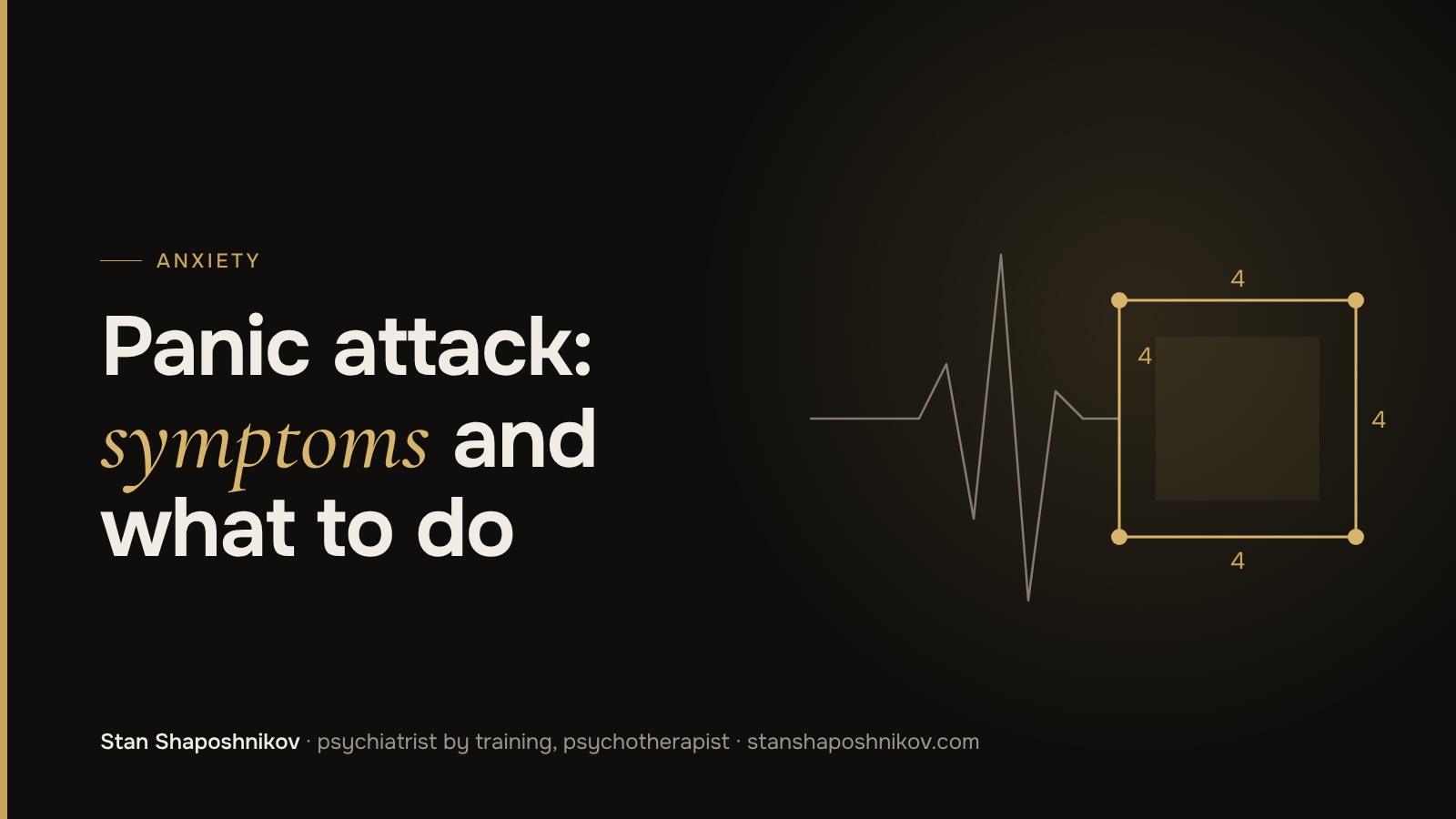
Box breathing, 4 by 4, is the first technique I give my clients:
- Breathe in through your nose for a count of 4.
- Hold for 4.
- Breathe out through your mouth for 4.
- Hold for 4.
Repeat for 3–5 minutes. During a panic attack people breathe fast and shallow, which causes dizziness and numb fingers. An even count steadies the breathing, and those symptoms go away. Don't try to breathe in as deeply as possible: that makes the dizziness worse.
3. Shift your attention to your breath
Once your breathing has steadied, simply watch it. How the air comes in through your nostrils, how your belly rises and falls. If your attention drifts to frightening thoughts, calmly bring it back to the breath. There's no need to argue with the thoughts; just keep turning your attention back.
4. Come back to the present moment
If breathing doesn't help, bring in your senses. Find 5 objects around you with your eyes, listen for 4 sounds, feel 3 points of support: your feet on the floor, your back against the chair, your palms on your knees. This brings you back from a frightening future ("something terrible is about to happen") to the present, where nothing is actually happening.
5. Don't run away
The most natural urge during an attack is to rush out of the shop, get off the train, never take a lift again. But every escape like that strengthens the link "this place is dangerous" in your mind. That's how the world gradually shrinks: a person stops taking the subway, going to shopping centres, leaving the house alone. If you can, stay where you are until the attack passes. That way you learn from your own experience that nothing terrible happened.
6. After the attack
Drink some water and give yourself a rest. Write down where and when the attack happened, what you were doing and thinking before it. After a few attacks a pattern usually shows up in the notes, and it's useful to bring them to a specialist.
How to help someone having a panic attack
If someone close to you is having an attack:
- speak calmly and briefly: "I'm here. This is a panic attack, it will pass";
- do box breathing together, counting out loud;
- don't say "calm down" or "pull yourself together": the person is already trying as hard as they can;
- don't drag them outside in a hurry or ask lots of questions;
- if there are signs of a heart attack from the list above, call an ambulance.
A case from practice: a panic attack in a lift
A man came to me whose first panic attack happened in a lift that got stuck. Claustrophobia came with it: after that day he couldn't enter a lift or any cramped space without a racing heart and a choking feeling.
First we used a dissociative technique. It lets a person relive the situation as if from the outside, like a scene in a film, without sinking into the same terror. This made it clear what exactly in the lift set off the reaction.
The trigger turned out to be something other than the confined space itself. As a child, this man had nearly drowned and was pulled out at the last moment. The feeling of "I can't breathe, there's no way out" in the stuck lift switched on that old memory, even though he had never consciously connected it with lifts.
From there the work went in two directions. Through body awareness he learned to notice the first signs of anxiety and bring his breathing back to an even rhythm. Through memetics we worked on the beliefs "I won't cope" and "I'm helpless" that had stayed with him since that day in the water. Gradually the attacks stopped, and he uses lifts again.
There are many stories like this, and they tend to be similar: the real cause of an attack lies deeper than the situation in which it happened.
How panic attacks are treated and which doctor to see
Start with a GP. Physical causes need to be ruled out: an ECG, thyroid hormone tests and a full blood count. If there are heart complaints, the GP will refer you to a cardiologist.
If the body is healthy, see a psychiatrist or psychotherapist. There's no need to fear the word "psychiatrist": panic disorder is an anxiety disorder, it has nothing to do with "madness." A psychiatrist decides whether medication is needed. Usually these are antidepressants that lower the overall level of anxiety, while tranquillisers are prescribed only in short courses because they are habit-forming. Medication and doses are chosen only by a doctor in person. I don't prescribe medication myself; my work is psychotherapy.
Psychotherapy. A well-studied method for panic attacks is cognitive behavioural therapy (CBT). In my work I combine CBT with analysing the "firmware" through memetics: we find the beliefs that set off fear again and again, and change them. This usually takes 5–8 sessions. Medication and psychotherapy don't exclude each other; they often work together.
The sooner you start, the faster the result. While attacks are still rare and the person hasn't started avoiding places and situations, the work goes noticeably easier.
Frequently asked questions
Can you die from a panic attack?
No. A panic attack doesn't damage the heart or the brain, even when the sensations are very strong. But a first attack with chest pain should be checked by a doctor to rule out heart problems.
How long does a panic attack last?
Usually 5 to 20 minutes. It peaks in the first 10 minutes, then the symptoms fade. Weakness after an attack can last several more hours.
Can a panic attack raise blood pressure?
Yes. During an attack adrenaline is released, and blood pressure and pulse rise. After the attack they return to normal. If your blood pressure stays high, see a GP.
How do you stop a panic attack on your own?
Name it as a panic attack, do 4-by-4 box breathing and shift your attention to your breath or to the objects around you. Don't flee the situation if you can stay. The attack will end by itself, and each time you'll fear it less.
Which doctor should I see for panic attacks?
First a GP, to rule out heart and thyroid problems. If your body is fine, a psychiatrist if medication is needed, or a psychotherapist to work on the causes of the attacks.
Will panic attacks go away on their own?
Sometimes attacks stop once severe stress is gone. But if they keep coming and you have started avoiding the places where they happened, they usually don't go away by themselves; instead the list of "dangerous" situations gradually grows.