Career change after 35: how to decide without starting from zero
Your work stopped bringing joy long ago, but leaving is scary: "it's too late", "I'll lose everything", "what if it doesn't work". Which of these fears are real, which ones we inherited, and how to plan the transition.
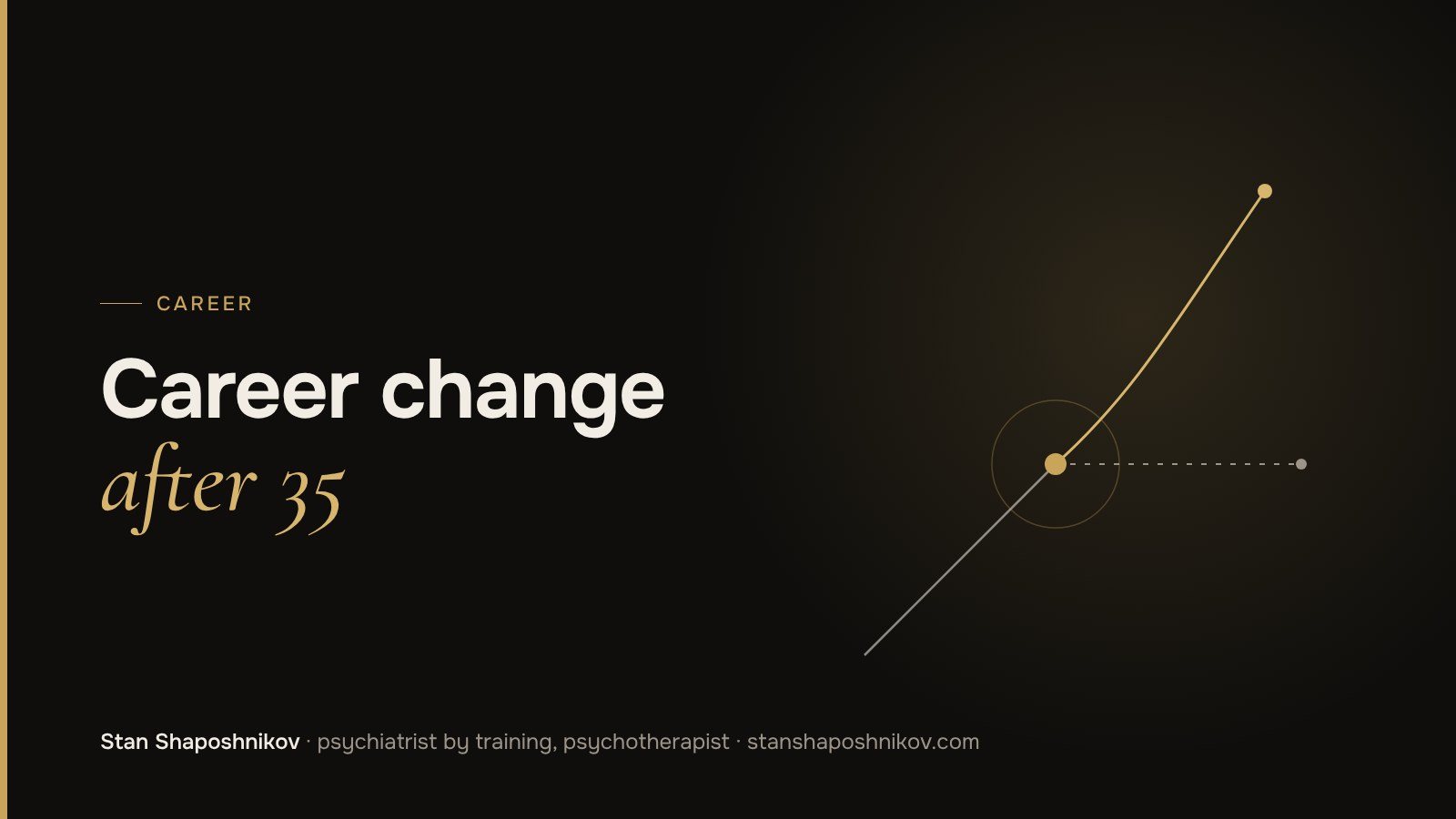
You're 35, 40 or 45. You have experience, a reputation and a predictable income. And you have a feeling that you're doing the wrong thing. Work brings no joy; you look at people in other fields and think: "I wish I were there." And then: "Too late. Who would hire me? I'll lose everything I've built."
This is one of the most common questions people now take to forums and to specialists. Many have already decided: they are changing careers, starting businesses, going back to study. Many others have been standing on the threshold for years.
Why it's so frightening
The fear of changing careers in mid-life has several layers.
Real risks. A temporary drop in income, the need to study, competition with younger specialists. These have to be taken into account and planned for.
Loss of status. In your field you are an expert and people listen to you. In the new one you'll be a beginner. For many this hurts more than losing money.
Inherited rules. "You choose a profession once", "someone who changes jobs often isn't serious", "at forty it's too late to study". We heard these from parents, teachers and older colleagues. They describe the world our parents lived in — one employer for life and a pension from one place. That world is gone, but the rules keep running in our heads.
In the memetics of personality these rules are called memes: ideas we absorbed uncritically and that drive our decisions even though we never chose them.
Three questions before you decide
1. What am I running from, and what am I going towards?
Sometimes the wish to change careers is really a wish to get away from a particular boss, team or schedule. Then changing careers won't help: the problem will move with you. Be honest about what you dislike in the profession and what you dislike in your current workplace.
2. What do I really want, and what just looks attractive from outside?
Other people's work often seems more interesting because we see its façade. Before you leave, talk to three to five people who work in the new field and ask what their ordinary Tuesday looks like. Not the brightest moments — the routine.
3. What from my experience do I take with me?
Changing careers almost never means "starting from zero". Experience in management, negotiation, working with people and industry knowledge all transfer. Often the strongest transition is the one where you combine old expertise with a new field.
Typical mistakes
- Leaving into nothing. Quitting without testing the new field in practice and ending up with no income and no idea whether you like the new work.
- Studying forever. A fifth course, a tenth certificate — and still not starting work. Studying sometimes becomes a way of postponing the frightening step.
- Waiting for confidence. Confidence comes after the first results, not before them. Waiting for it can take years.
- Deciding alone. Isolation amplifies fear. People who have walked a similar path help you see the real risks rather than imaginary ones.
How to plan the transition
- Test the hypothesis small. A freelance project, volunteering, weekend work, an internship. The goal is to find out whether you like it in practice.
- Calculate your financial cushion. How many months can you live on a reduced income? This turns an abstract fear into a specific number.
- Find a bridge. A role or project where your previous experience is useful and new experience appears at the same time. For example, a lawyer moving into training can start with corporate training for lawyers.
- Set a date. Not "someday" but a specific month by which you will decide based on what your tests showed.
When it's worth working with a coach
If you've been thinking about a career change for years but never start, it is usually not a lack of information. It's beliefs that slow the decision: "you mustn't take risks", "I have no right to make mistakes", "what will people say". In coaching we look at which of them are yours and which were inherited, and build a transition plan you can actually carry out.
The first 30-minute call is free. Book a free call.
Frequently asked questions
Is it too late to change careers at 40?
For most professions, no. People with experience have advantages: they can work with people, take responsibility for results and understand business. The key is not to start from zero but to build the transition so your previous experience works for you.
How can I change careers without losing income?
Combine: test the new field through projects and side work while keeping your main income, and save a financial cushion in advance for the transition period. Leaving abruptly without preparation is the riskiest option.
How do I know I really want to change careers and I'm not just tired?
If the wish disappears after a holiday and a change of workload, it was probably fatigue. If you are drawn to a specific other activity and are ready to try it in practice, it looks like a real wish for change.
How long does a career change take?
Usually from six months to two or three years, depending on how far the new field is from the old one and how much you need to learn. Plan it in stages, with checkpoints.