What is an abuser? 12 signs in a relationship
A psychotherapist explains how abuse differs from ordinary arguments, how the cycle of abuse works and why leaving is so hard even when everything is clear.
The word "abuser" has become popular in recent years, and it is often used too broadly: for a rude boss and for a partner who once raised their voice. Because of this, real abuse is sometimes hard to see. It rarely starts with shouting. More often it starts with care, jealousy "out of love" and small remarks after which a person trusts themselves a little less each time.
Let's look at what an abuser is in plain words, the signs that reveal one in a relationship, why it is so hard to leave and what to do if you recognise your partner.
What an abuser is, in plain words
An abuser is a person who systematically harms another in order to control them. The word comes from "abuse": misuse, cruel treatment.
The key words here are "systematically" and "control." Every couple argues. Abuse is different because:
- it repeats, rather than happening once;
- the power is unequal: one decides, the other adapts and is afraid;
- the goal is to subdue and hold on; solving the problem doesn't interest the abuser;
- after an episode the other person feels guilty, even though they are the one who was hurt.
An abuser can be a man or a woman, a husband, wife, parent or boss. Most often the word is used about close relationships, where an abuser does the most harm.
Types of abuse
Abuse isn't necessarily about beatings. The most common forms are:
- Psychological (emotional). Humiliation, insults, belittling, threats, ignoring, gaslighting, when a person is convinced they remember and understand events wrongly.
- Physical. Pushing, hitting, holding by force, damaging belongings, threats of physical harm.
- Financial. Control over money, forbidding work, demanding an account for every purchase.
- Sexual. Pressure into intimacy, ignoring refusal, humiliation in the sexual sphere.
- Social isolation. Limiting contact with friends and relatives, jealousy of any contacts.
- Digital. Checking the phone and messages, demanding passwords, tracking by geolocation.
The forms often combine. Physical violence almost always begins after a long period of psychological abuse.
12 signs of an abuser in a relationship
No single sign makes a person an abuser. But if you recognise several, especially if they repeat, it's worth taking seriously.
- Getting close too fast. At the start, lots of attention, gifts, declarations, talk about "destiny." The relationship moves at high speed.
- Jealousy passed off as love. "I just love you, that's why I don't like you seeing them."
- Control. Where are you, who with, why didn't you answer right away, show me your phone.
- Isolation. Gradually there are fewer and fewer friends and relatives in your life: "they're a bad influence on you."
- Criticism and belittling. Your looks, work, abilities, friends. Often disguised as a joke or as care: "I'm only trying to help you."
- Shifting blame. In any argument you are to blame: "you drove me to it," "if only you hadn't…"
- Gaslighting. "That never happened," "you're making it all up," "there's something wrong with your memory."
- Sharp swings. Tenderness and care today, coldness or rage tomorrow with no clear reason.
- Punishment by silence. The person ignores their partner for weeks until they apologise.
- Threats. To leave, take the children, hurt themselves or you, reveal your secrets.
- No respect for boundaries. Your "no" isn't accepted: in sex, in money, in plans.
- You're constantly walking on eggshells. You watch every word so as not to set off an outburst.
The last sign is often the most telling. If you think more about your partner's reaction than about your own feelings, the relationship is already built on fear.
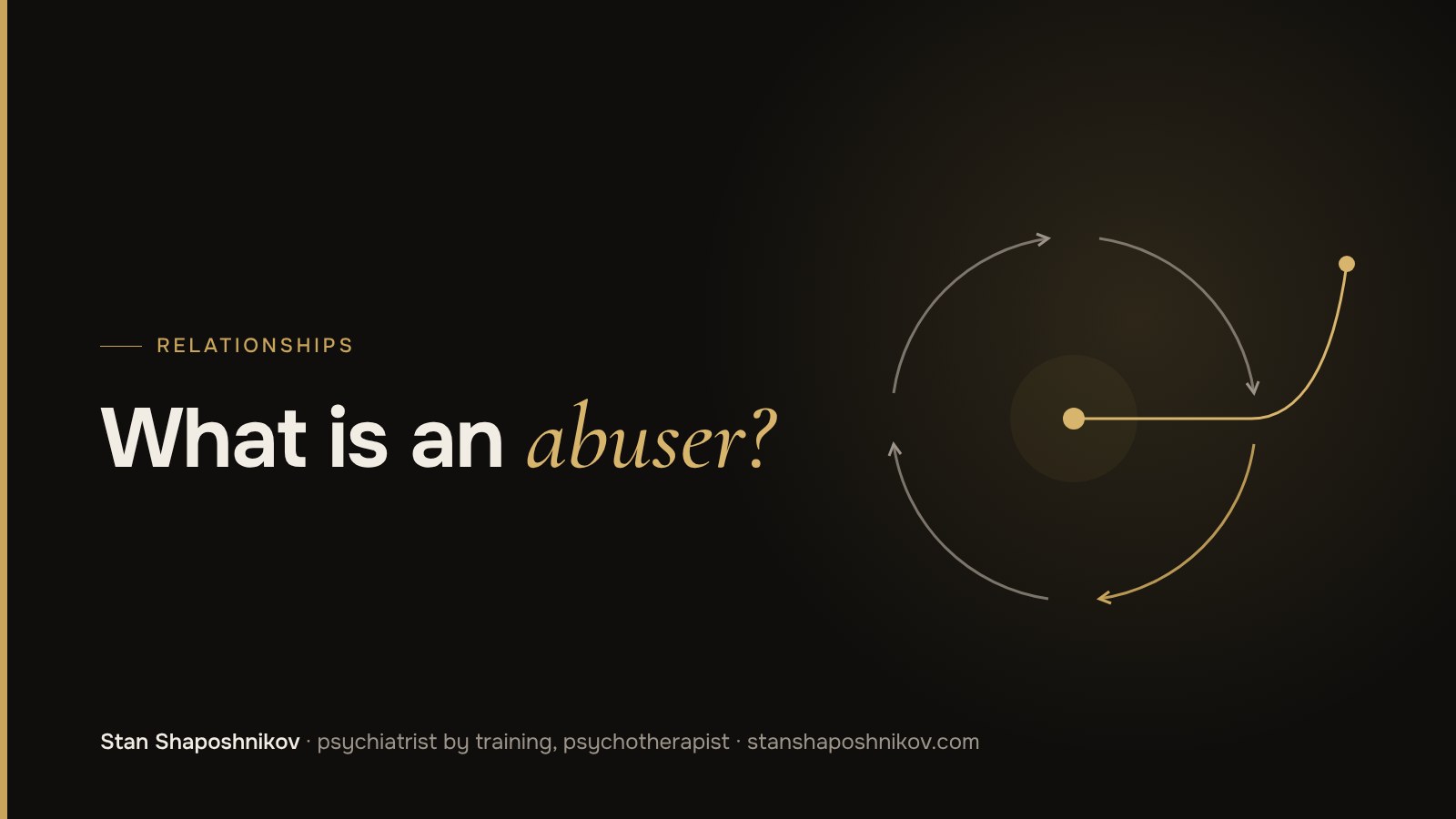
The cycle of abuse: why it keeps repeating
In the 1970s psychologist Lenore Walker described a repeating cycle that many people recognise in their relationships:
- Tension building. The partner is irritable and finds fault; you try to smooth everything over.
- Outburst. Insults, threats, violence.
- Reconciliation. Apologies, tears, gifts, promises to change. Sometimes the abuser shifts the blame: "I snapped because you…"
- Calm, or the "honeymoon." Everything is like the start of the relationship. It seems the worst is over.
Then the tension grows again. Over time the calm phase gets shorter and the outbursts stronger. It is the reconciliation phase that keeps people in the relationship: they remember how good the partner can be and hope they will stay that way.
Why it's hard to leave an abuser
From the outside it seems enough to just pack your things. From the inside it's different.
- Fear. For yourself, for the children, of what will happen after leaving. The period of separating from an abuser really can be the most dangerous.
- Dependence. Financial, practical, emotional.
- Losing your footing. After months of isolation and gaslighting a person stops trusting their own perception and isn't sure they can cope alone.
- Hope. Each reconciliation phase promises that everything will change.
- Learned beliefs. Here what I call "firmware" in the memetics of personality is at work. If in the family where a person grew up it was normal to put up with things ("everyone lives like this," "for the children's sake," "if he hits you, he loves you," "it's your own fault"), these attitudes switch on automatically. They don't make a person to blame for the abuse, but they explain why it's so hard to see it from the inside and leave.
Abusers, too, often repeat what they saw in childhood. That doesn't excuse their behaviour: responsibility for violence always lies with the person who commits it.
What to do if you recognise your partner
If there is a threat to life and health, call emergency services (112 in Europe or your local number). This is the most important rule.
If there is no immediate danger:
- Write things down. Dates, words, events. It helps you keep hold of reality when you're told "nothing like that happened," and it will be useful if you need protection.
- Reconnect with people close to you. Tell at least one person you trust. Isolation is the abuser's main tool.
- Make a safety plan. Where to keep documents and money, who you can go to, which phone numbers to know by heart.
- Turn to a specialist. A psychologist or psychotherapist will help you regain trust in yourself and make a calm decision. Many countries have crisis centres and hotlines for survivors of domestic violence, and their help is usually free.
- Don't try to "re-educate" your partner on your own. An abuser can change only if they admit the problem themselves and work with a specialist for a long time. Your love and patience can't replace that.
Ordinary couples therapy isn't recommended in cases of abuse: the victim often can't speak freely, and the abuser uses what was said against them. Safety and individual help come first.
Abuse or ordinary conflict: how to tell
| Healthy relationship | Abusive relationship | |
|---|---|---|
| Arguments | about a specific problem | about you being "wrong" |
| After an argument | both look for a solution | you apologise, even if you were hurt |
| Your "no" | accepted, even if they're unhappy | pressure, sulking, punishment |
| Friends and family | part of life | gradually disappear |
| Your feelings | calm and trust | fear, guilt, confusion |
Frequently asked questions
What is an abuser in plain words?
A person who systematically harms a partner or someone close in order to control them: humiliates, isolates, intimidates, belittles, sometimes uses physical violence.
What are the main signs of an abuser?
Control and jealousy, isolation from friends and family, constant criticism, shifting blame, gaslighting, sharp swings from tenderness to aggression, threats and no respect for your "no."
Can a woman be an abuser?
Yes. An abuser can be of any gender. Abuse by women is more often psychological: belittling, manipulation, control, threats to take the children, but physical violence also occurs.
Can an abuser change?
Sometimes, if they admit the problem themselves and work with a specialist for a long time. Promises after an argument, tears and gifts usually turn out to be part of the cycle of abuse. Change is shown by actions over months.
Why does a victim go back to an abuser?
Because of fear, financial and emotional dependence, hope for change and lost trust in oneself. Beliefs learned in childhood are often at work too: "you have to put up with it for the family's sake."
Does couples therapy help with abuse?
Usually not. Specialists recommend starting with individual help for the person who was hurt and with their safety. The abuser needs separate work.